The Day the Client Sent That Email
The email landed at 4:47 PM on a Thursday. It came from Dr. Park's project lead, and it was short enough to memorize instantly:
“The qPCR results for Plate 7 show high variance in the reference wells. Our internal analysis suggests a pipetting issue. Can we discuss tomorrow morning?”
I stared at my screen for a while (not that staring helped). Plate 7 was ours. Twelve of 384 wells had failed — a terrible ratio for a lab that charged a premium for reproducibility. The rework would eat $890 in reagents and three days of technician time. We couldn't bill any of it to the client.
Worse was what Dr. Park didn't write. I could feel the real question between the lines: Is this lab actually reliable?
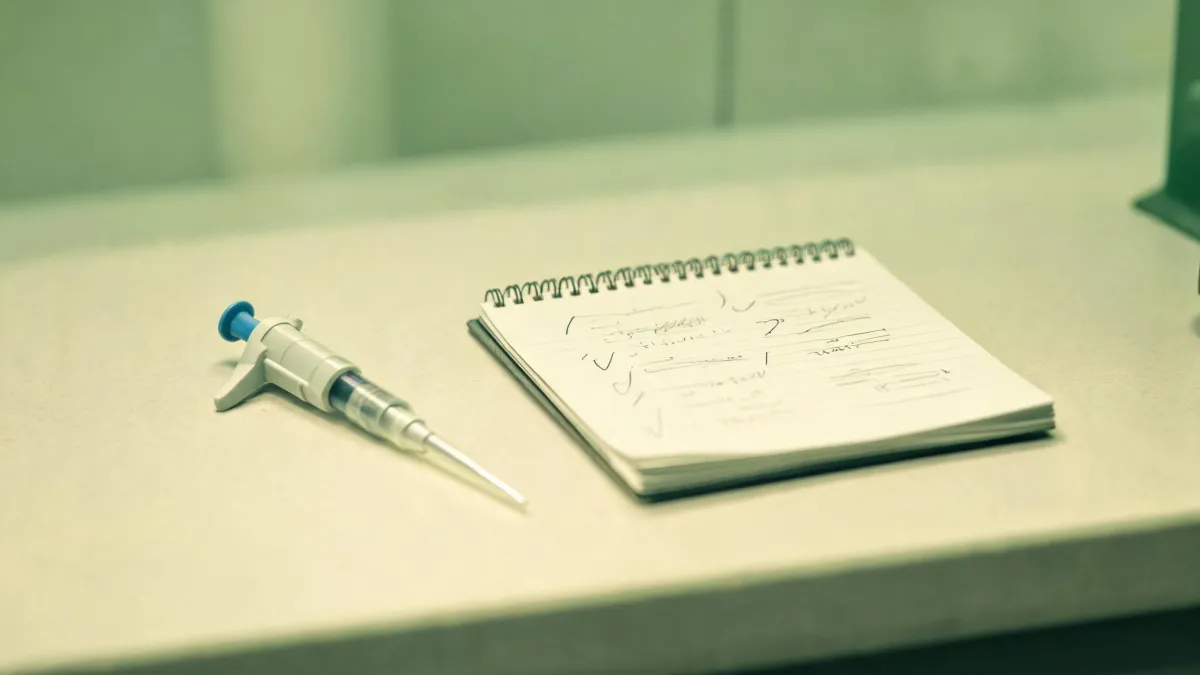
That was the moment I learned that the tools we use are the face we show clients. If a pipette misfires in front of a client, they don't see a bad batch. They see an unreliable lab.
Looking back, I've handled lab equipment orders for eight years now, and I've made — and documented — four significant procurement mistakes totaling roughly $7,400 in wasted budget. The worst one started the way these things usually do: with a decision that looked completely rational on paper.
How I Ended Up with 24 “Compatible” Pipettes
Let me rewind to 2016. I'd just taken over equipment procurement for a molecular biology lab doing contract research: RNA extraction, reverse transcription, qPCR, the works. The mandate from leadership was simple: cut costs without cutting corners.
So when a distributor offered “equivalent-quality” pipettes at about half the price of Eppendorf Research Plus pipettes, I felt pretty clever. The spec sheets looked great — same volume ranges, autoclavable, adjustable tip ejector. They also dangled a bulk deal: 24 pipettes for the lab, plus a discount on a private-label PCR machine that was, in the sales rep's words, “the same as the big brands without the logo.”
I ran the numbers. The savings versus the Eppendorf quote came to about $3,200. On paper, it was the obvious decision.
It ended up being the most expensive penny-pinch of my career.
What the Spec Sheet Didn't Tell Me
It's tempting to think you can just compare spec sheets. But two products with identical printed specs can behave very differently after months of daily handling.
The first three months were fine. Then the calibration reports started coming back.
We send every pipette out for calibration every 12 months — at least, that was the plan. Within the first year, two of the 24 units came back with drift beyond our acceptance limits. After the second calibration cycle, seven units had failed at least once — including two pipettes off by nearly 3% at the 100 µL setting. Both the budget pipettes and the Eppendorf units claimed to meet ISO 8655 calibration standards. Here's what I learned: that standard tests a unit under controlled, ideal conditions. It doesn't predict drift under daily use, or how materials hold up to repeated autoclaving, or whether the factory's quality control is actually consistent from batch to batch.
From the outside, the budget pipettes looked identical to the Eppendorf ones we'd used before. The reality was hidden in the calibration reports and, eventually, in a client's failed plate.
The recalibration fees stung — $15 per unit, every cycle. But the quiet damage was worse. Slightly-off volumes produce slightly-off results. Most of the time we caught them. “Most of the time” is not a slogan you want for a lab, by the way.
The September 2019 failure was the one we couldn't catch. A technician flagged her pipette as “feeling sticky” a week before a big qPCR run. I approved the run anyway because the unit's calibration certificate was still technically valid. Twelve wells failed. The client noticed. That's the thing about quality problems: they show up — probably — at the worst possible moment.
The Private Label Trap
Here's what I know now: many “distributor brand” or private-label lab instruments are made by OEMs that sell multiple quality tiers. The budget tier shares the marketing language but uses cheaper components and looser quality control. The sales rep used words like compatible and equivalent. He never said identical. And I never asked why Eppendorf cost more.
The same near-miss happened with a PCR machine private-label offer. It was tempting at about $8,900 versus roughly $15,200 for a major brand. Same sample capacity, similar software, similar price gap to what we'd seen with the pipettes. I built a spreadsheet that said “save the $6,300.” But my gut said the vendor's support was too slow: sales questions got answered within a day, technical questions in three days, sometimes more.
Every cost analysis pointed to the budget option. Something felt off. I put the purchase on hold anyway. A few months later, a neighboring lab bought that same private-label PCR machine and spent a month chasing a temperature-consistency problem — with support that clearly didn't know the product well. I barely dodged a $6,300 mistake by listening to the uneasiness instead of the spreadsheet.
Switching to Eppendorf Research Plus
In November 2019, I ordered 24 Eppendorf Research Plus pipettes.
Even after placing the order, I kept second-guessing. What if the premium didn't change anything? What if our workflows were fine with cheaper tools and I was just being paranoid? The six weeks until the first calibration cycle were stressful.
Then the report came back: all 24 units within tolerance. Zero unexpected drift. That first clean report was the moment I finally exhaled.
In daily use, the differences are not dramatic, but they're tangible:
- The ejection force is noticeably lighter, which matters when your technicians run 384-well plates all day.
- The volume adjustment stays precise and readable after months of use.
- Autoclavability held up: we sterilized the pipettes dozens of times without visible degradation.
- The adjustable finger rest fits different hand sizes — a small detail that our team genuinely appreciates.
I'm not here to claim any pipette is perfect for every lab. In our experience, though, Eppendorf Research Plus pipettes held their calibration — and that consistency is exactly what a results-driven lab needs.
The Procurement Checklist I Now Use
We didn't have a formal incoming QC process back in 2016. That gap cost us a lot. After the third quality headache, I built one. It's not complicated, but it works:
- Gravimetric spot-check. Weigh-test at least three units from every batch before putting them into service. Don't trust the brochure.
- Ask about the OEM. If it's private label — especially a PCR machine private label — ask who actually manufactures it and whether QC standards match the branded version.
- Request batch-specific calibration data. Not a generic spec sheet. Actual documentation from that production lot.
- Calculate total ownership cost. Calibration frequency, service response time, rework risk, and the true cost of a failed experiment.
- Test the support channel before ordering. Send a real technical question and measure how long they take to answer it properly.
Since I put this checklist in place, our team has caught 47 potential problem orders in 18 months. I know that number sounds oddly precise; it comes straight from our audit log. Most were minor, but the checklist prevented the big one: repeating the same $3,200 mistake twice.
Quality Is Brand Image
If you run a lab, your clients don't see your procurement spreadsheet. They see your results, your instruments, your data. When a client watches a pipette misfire, they don't think “bad batch” — they think “can I trust this lab?”
The same pattern shows up beyond lab equipment. I've watched teams hunt through a web page keywords analyzer distributor to save a few hundred dollars on SEO tools, or compare prices in a web traffic analyzer wholesale cost guide and pick the cheapest subscription — only to get unreliable data that leads to bad decisions. The cheap tool always looks rational on paper, until it's the thing producing your metrics, your samples, or your client's plate.
For us, the $3,200 saved in 2016 turned into roughly $7,400 in recalibration fees, rework, and lost credibility. The client stayed, but it took a year of flawless results to rebuild their trust. That cost never shows up on an invoice, but it's the most expensive line item of all.
So if you're buying pipettes — or a PCR machine, or anything that touches your experimental results — buy the tool you can trust, not the one that looks cheapest in a spreadsheet. Take it from someone who made the mistake so you don't have to.
